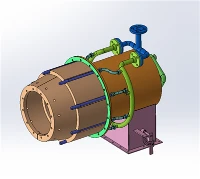
Heavy oil is a kind of liquid fossil fuel. Compared with natural gas and other gas fuels, the system is simpler, safer, easier to store and free from geographical restrictions. Compared with light oil, it is more economical and cheaper due to the difference in manufacturing technology. In recent years, with the rising price of high-quality fuel oil and natural gas, heavy oil has been increasingly valued as an alternative fuel in oil-producing countries such as the Middle East. In the Middle East and other countries with large reserves of heavy oil, heavy-oil-based boilers are the first choice for new power stations, so there is a considerable market for oil-fired units in some oil-producing countries. Heavy oil is the residue left after the fractionation of crude oil into gasoline, kerosene and diesel after heating and refining. Its ignition and burnout characteristics are easier than those of pulverized coal. In the combustion process, the formation of nitrogen oxides is part of the combustion reaction. NOx is generated in the combustion process of boiler fuel. There are three main ways of NOx generation: thermal type, fast type and fuel type. Thermodynamic type: during combustion, nitrogen in the air is oxidized at high temperature, and the formation process is a chain reaction with no branches. The mechanism of formation is called expanded teridovich odd mechanism. With the increase of reaction temperature T, the reaction rate increases exponentially. When T < 1500° C, little NO was produced, while when T>yog 1500 degree C, cov tshuaj tiv thaiv nce 6-7 zaug rau txhua txhua 100 degree C nce hauv T. Qhov cuam tshuam ntawm qhov kub ntawm thermal NOX yog qhov pom tseeb heev. Tsis tas li ntawd, cov cua coefficient ntau dhau, lub sijhawm nyob hauv, siab thiab lwm yam muaj qee yam cuam tshuam rau thermal NOX. Feem ntau, cov thermal NOX ntau lawm hauv cov txheej txheem ntawm cov roj combustion yog qhov loj tshaj plaws, suav txog 70% -80% ntawm tag nrho. Xyoo 1971, Fennimore tau npaj cov tshuaj tiv thaiv ntawm NOx tsim. Nyob rau hauv combustion ntawm hydrocarbon fuels, yog hais tias lub hydrocarbon concentration yog siab, ceev NOx yuav sai sai generated nyob ze thaj tsam ntawm cov tshuaj tiv thaiv. Tsis muaj ceev NOx yuav raug tsim nyob rau hauv cov nplua nuj roj combustion nrog tsawg oxygen concentration. Nyob rau tib lub sijhawm, ceev NOx muaj qhov tsis muaj zog ntawm qhov kub thiab txias, uas tsuas yog txiav txim siab ntawm qhov kub thiab txias, suav txog 15% -20% ntawm tag nrho.; Thaum kub kub, thermodynamic hom NOx ntau dua, hom ceev tuaj yeem tsis quav ntsej. Roj-raws li nitrogen oxides muaj ib feem me me. Tam sim no, lub hwj chim cog boiler siv roj burner, xws li los ntawm sab hauv lub tsho tiv no ntawm atomizing roj phom, ib tug duct thiab lub thib ob cua duct, atomizing roj phom nrog rau cov tubing thiab lub nozzle, yog txawm peem rau nrog ib tug lub voj voog nyob rau saum npoo ntawm lub ducts. nplhaib, nyob rau hauv pem hauv ntej ntawm lub nozzle yog teem ib tug xov tooj ntawm xws li txoj kab uas hla ntawm lub nozzle, lub nozzle tsuag lub kaum sab xis yog tib yam, nyob rau hauv lub thib ob cua duct nrog cyclone; Lub tshuab hluav taws xob txhawm rau ua kom tau raws li qhov xav tau ntawm cov cua sov, yuav tsum tau teeb tsa ntau lub qhov txau kom deb li deb tau, qhov no ua rau lub qhov deb ntawm lub nozzle yog ze, thaum siv, lub nozzle ntawm qhov hluav taws kub tau yooj yim ignition, nplaim hluav taws kub dissipation tsis zoo, siab combustion kub, tsim ntau nitrogen oxides tshav kub hom, nyob rau tib lub sij hawm nyob rau hauv nruab nrab ntawm lub combustion cheeb tsam kuj tsis tshua muaj oxygen concentration thiab siab concentration ntawm hnyav roj, kuj muaj ib tug tseem ceeb ib feem ntawm hom oxides generated sai thiab ua rau cov uas twb muaj lawm. Nyob rau hauv hnyav roj boiler combustion yog ib qho yooj yim los tsim high nitrogen oxide (NOx) emissions, emissions ntawm nitrogen oxides feem ntau mus txog 800 mg / Nm3, tsis tau raws li qhov yuav tsum tau ntawm kev tiv thaiv ib puag ncig.
Lub hom phiaj ntawm cov qauv siv hluav taws xob yog muab cov roj burner hnyav, uas tuaj yeem txo qhov tsim ntawm nitrogen oxides, ua tau raws li qhov yuav tsum tau ua ntawm kev tiv thaiv ib puag ncig, thiab muaj kev lag luam dav dav hauv kev pom ntawm qhov tsis txaus ntawm cov thev naus laus zis uas twb muaj lawm. Tam sim no, cov nqi roj av thoob ntiaj teb poob qis, txhawm rau kom txuag tau cov nqi, cov chaw tsim khoom siv hluav taws xob siab tau hloov hom hluav taws xob siv rau cov roj hnyav, lub tuam txhab hauv kev nyab xeeb thoob ntiaj teb no, lub zog hluav taws xob los ntawm cov roj ntuj rau cov roj hnyav. Txawm li cas los xij, piv nrog cov roj av, cov roj hnyav muaj ntau yam impurities thiab hnyav hnyav. Thaum lub qhov cub tawg, nws yog ib qho yooj yim los tsim cov pa roj carbon nyob rau hauv cov phab ntsa sab hauv thiab txoj hauj lwm ntawm lub taub hau rab phom, thaum lub sij hawm siv cov roj qub, cov cua compressed yog siv los ntxuav thiab cov roj diesel siv los ntxuav lub taub hau phom. Txoj kev ntxuav saum toj no yog qhov nyuaj rau kev ntxuav cov pa roj carbon monoxide, thiab thaum lub qhov cub qias neeg raug teeb tsa dua rau kev sib txuas, nws yog ib qho yooj yim ua rau hluav taws sib txawv, txawm tias thaiv thiab ploj mus, ua rau qhov kub thiab txias ntawm qhov cub, los yog cuam tshuam rau cov khoom qub. , yog li thawj txoj kev tu tsis tuaj yeem ua tau raws li qhov xwm txheej tam sim no.